THE COMPLETE PARENTS' GUIDE TO BRAZILIAN JIU-JITSU FOR KIDS IN SINGAPORE
By Brendan Foong, Programme Director

Is Brazilian Jiu-Jitsu right for your child?

Choosing a martial art for your child is an important decision. Parents often want something that develops confidence, discipline and physical ability while ensuring their child trains in a safe and positive environment.

Brazilian Jiu-Jitsu (BJJ) is a martial art based on grappling, control, problem-solving and technique. Unlike striking-based martial arts, BJJ focuses on using leverage, positioning and timing to control an opponent.

For children, BJJ is not simply about learning techniques. It develops confidence, resilience, teamwork, problem-solving, physical coordination, discipline and self-defence awareness. At The Gentle Art Academy, our children's programme is designed around how children learn and develop at different stages of growth.

Age-appropriate Brazilian Jiu-Jitsu development
What children can realistically learn at each stage

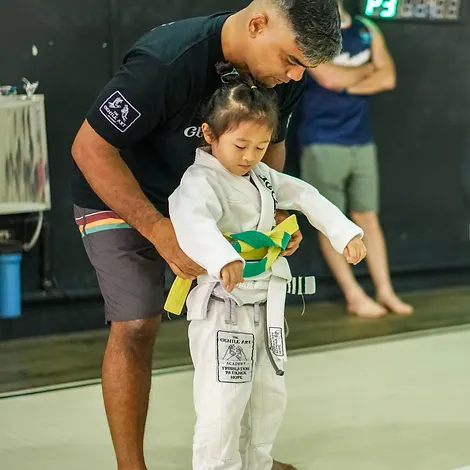
At The Gentle Art Academy, we recommend children start BJJ from approximately four years old. This is when most children can gain real value from structured technical coaching. Younger children often still experience separation anxiety and may find it difficult to remember and apply technical sequences. Every child develops differently, so our coaches help each student progress according to their individual needs.

Ages 4–6: Strong Foundations

Children learn to socialise and partner well with teammates, follow basic sequences and instructions, and understand foundational positions, escapes and self-defence concepts. Success means becoming a better learner, teammate and problem solver—not simply winning matches.

Ages 7–9: Detailed Technical Learning

Students typically have better coordination, longer attention spans and a stronger ability to remember and execute detailed sequences. Progress depends on listening carefully, practising consistently and being a good training partner. TGA has coached multiple national and regional champions in this age group.

Ages 10+: Advanced Athletic Development

Students begin developing physically and can handle more advanced training. Alongside BJJ, we strongly encourage wrestling, strength and conditioning, and broader athletic development. Our syllabus has helped athletes win world championships and qualify for national teams.

IS BRAZILIAN JIU-JITSU SAFE FOR CHILDREN?

Safety, supervision and responsible training

One of the most common concerns parents have is whether BJJ is dangerous. Like any physical activity, safety depends heavily on coaching quality, training structure and supervision. As there is no striking in BJJ, the risk of bruising and injury is mitigated.

Since 2014 we have trained over a thousand students and with our extensive experience, safety is one of our highest priorities. Students learn that techniques should only be applied during supervised training, appropriate competition or a genuine self-defence situation. Coaches actively monitor training and step in before positions become unsafe. Strong coach-to-student ratios ensure children receive guidance and support.

BJJ teaches control, respect and technical understanding rather than aggression. We will always step in to regulate a student's emotions and have them focus on proper technical application rather than trying to win with strength or power alone.


HOW CHILDREN ARE PAIRED FOR SPARRING

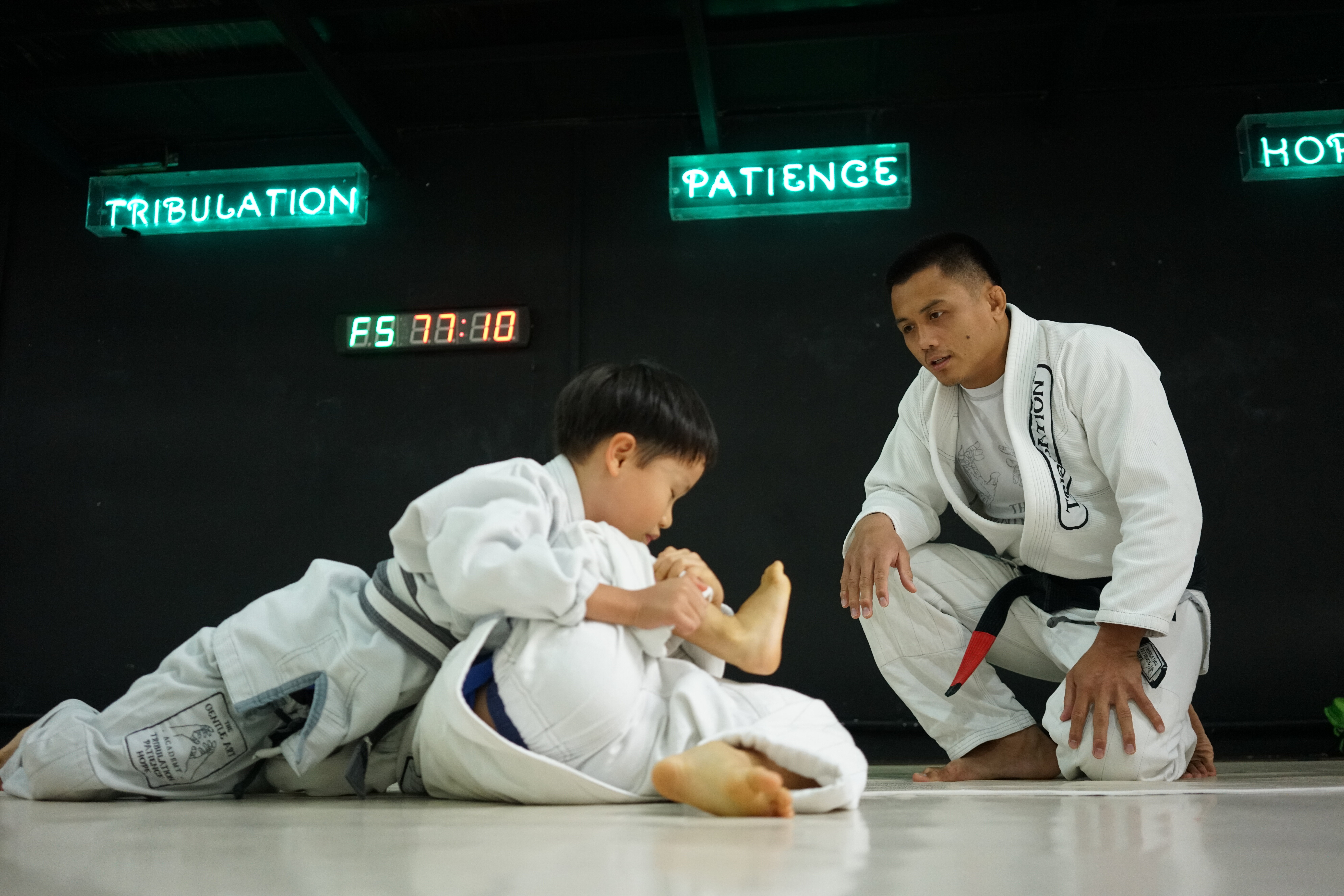
As the coaches take the time to get to know each student and their abilities, children are paired carefully by age, size, technical ability and experience. Every student develops at their own pace. Appropriate pairing helps children practise successfully, build confidence, avoid feeling overwhelmed and develop strong training relationships. A good training partner is an important part of learning Brazilian Jiu-Jitsu.


WHAT IF MY CHILD IS SHY OR NERVOUS?

It is completely normal for children to feel nervous when starting a new activity. Our coaches use positive encouragement, patient coaching and supportive training partners to help them settle in gradually. Since establishing TGA, we have taught thousands of students. Many children who initially feel shy become enthusiastic participants once they feel comfortable and supported.
How is Brazilian Jiu-Jitsu different from other martial arts?
BJJ compared with Taekwondo, Karate and Judo

Brazilian Jiu-Jitsu differs from many martial arts because children learn through live, controlled grappling and practical problem-solving. Instead of relying on memorised movements alone, students practise positioning, balance, escapes and control with training partners who respond and move. This helps children develop timing, adaptability and composure under pressure in a supervised environment.


Brazilian Jiu-Jitsu compared with Taekwondo and Karate

Taekwondo and Karate are primarily striking arts, with training commonly focused on punches, kicks, forms and distance management. BJJ is a grappling art: students learn how to close distance, control positions, escape safely and apply techniques without depending on strikes. This makes the learning experience more like physical problem-solving, with children receiving immediate feedback as they practise with a partner.


Brazilian Jiu-Jitsu compared with Judo

BJJ and Judo share historical roots and both use grips, takedowns and ground control. Judo generally places greater emphasis on throws and stand-up exchanges, while BJJ spends more training time on ground positions, guard, escapes, transitions and submissions. The two arts complement each other well, and experience in Judo or wrestling can strengthen a child's overall BJJ development.

Should children compete, and how often should they train?
Competition is optional; consistency supports progress

Competition is not required for every child, but it can be a valuable way to test skills under pressure, understand strengths and weaknesses, and develop confidence. Against unfamiliar opponents, students learn to apply techniques beyond the habits of regular teammates. At TGA, competition is a positive community experience where students enjoy the journey, celebrate progress and support one another.

For beginners, we recommend training at least three times per week. This supports our Learn → Practice → Apply philosophy: children learn a concept, practise it correctly and apply it during live training. Consistency accelerates skill development, confidence and retention.

Understanding the IBJJF Belt System for Kids
How children progress from white to green belt in Brazilian Jiu-Jitsu

The International Brazilian Jiu-Jitsu Federation (IBJJF) belt system helps students progress through age-appropriate stages as they develop their skills, confidence and character.

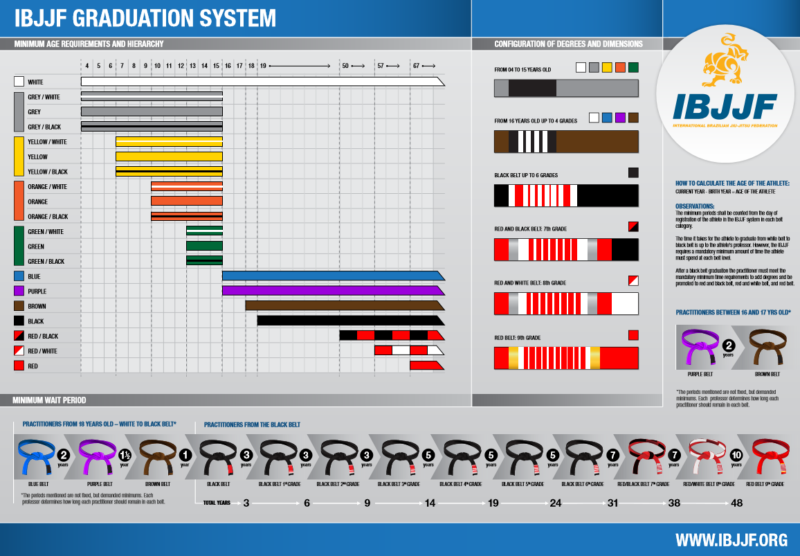
Children begin with the white belt and may progress through grey, yellow, orange and green belt groups. Each colour group includes white-striped, solid-colour and black-striped belts, creating achievable milestones along the way. These youth belts are available according to minimum age requirements, with green being the highest children’s belt level.

From age 16, students transition into the adult system: white, blue, purple, brown and black. Red-and-black, red-and-white and red belts are senior ranks reserved for highly experienced practitioners with decades of dedication to Brazilian Jiu-Jitsu.

Stripes may also be awarded between belt promotions to recognise steady improvement. Coaches consider more than technical ability—they may also look at attendance, effort, behaviour, resilience and the student’s ability to apply skills safely.

Every child develops at their own pace, so promotion timelines will vary. A belt is not simply a reward for winning competitions; it reflects consistent growth, maturity and commitment. The most valuable progress is often seen beyond the belt itself: greater confidence, discipline, perseverance and respect for others.

IBJJF Brazilian Jiu-Jitsu belt system for children and adults

IBJJF belt progression for children and adults.

What makes The Gentle Art Academy different?
A structured programme designed around how children learn

TGA's children's programme is built around more than teaching isolated techniques. We have partnered with experts in childhood development so our coaching aligns with modern learning principles. A progressive syllabus supports technical development, age-appropriate learning, confidence, communication, resilience, discipline and problem-solving. Our coaches bring thousands of hours of experience helping beginners become confident martial artists and successful competitors.

BJJ can also help children handle bullying and self-defence situations through awareness, control and confidence—not confrontation. Children learn emotional control, physical awareness, calm problem-solving and respect for boundaries.

When choosing a children's BJJ academy, parents should look for coaches experienced with children, strong safety systems and supervision, a progressive syllabus, a supportive training environment and a focus on long-term development beyond competition results.

Start your child's Brazilian Jiu-Jitsu journey

At The Gentle Art Academy, our mission is to help children develop confidence, resilience and lifelong skills through Brazilian Jiu-Jitsu.

Whether your child is completely new to martial arts or developing competitive ability, our coaches are here to guide them in a safe, structured and supportive environment.

×